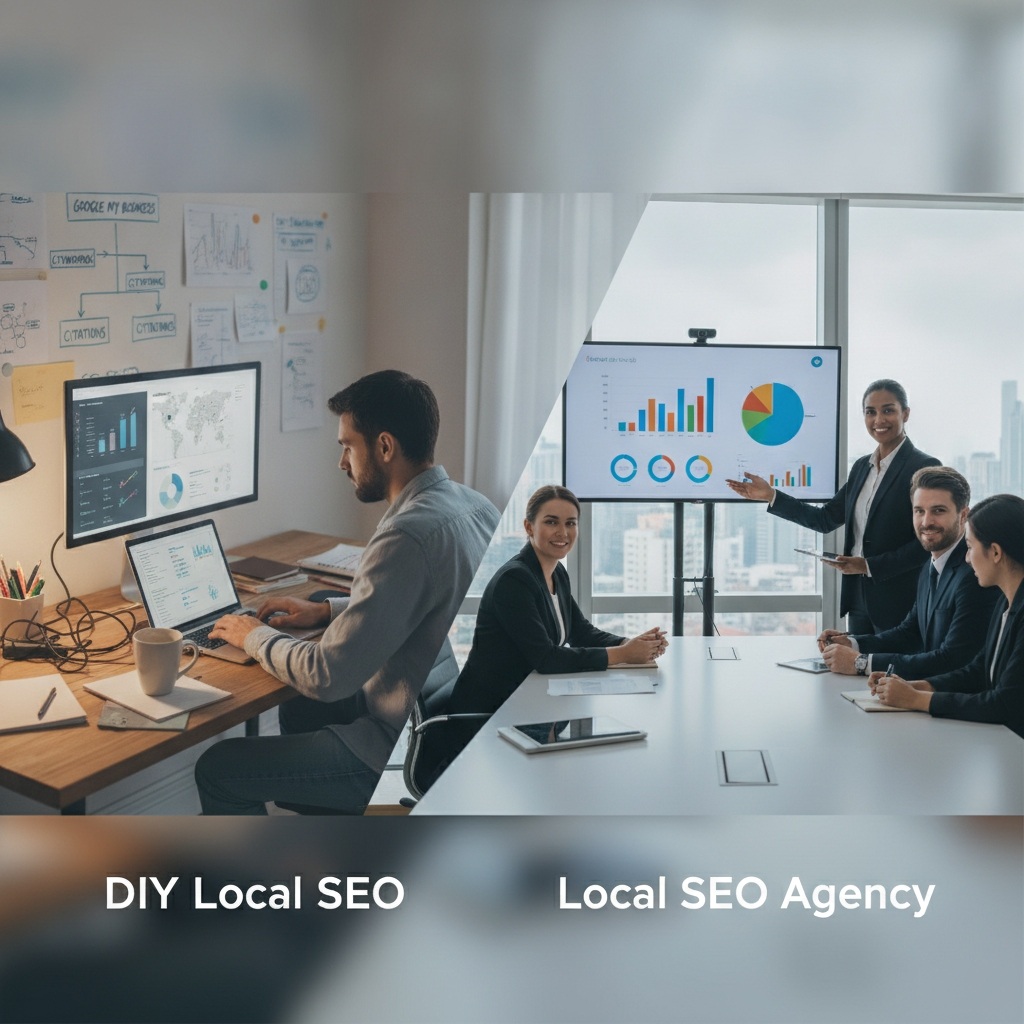
Introduction: The Local SEO Crossroads
Picture this. You own a small business. Maybe you run a pizza shop, fix people's plumbing, or clean teeth for a living. You know that getting found on Google is huge. After all, when was the last time you looked up a business in a phone book? Probably never.
So you start hearing about something called "local SEO." It sounds important. And it is. Local SEO is what helps people find your business when they search for "best pizza near me" or "emergency plumber in [your city]." Without it, you're basically invisible online.
But here's the problem. You're not a marketing expert. You're a business owner. You have customers to serve, employees to manage, and a hundred other things on your to-do list. So you're faced with a big question: should you learn local SEO yourself, or should you hire a local SEO agency to do it for you?
This is what we call the local SEO crossroads. It's the moment where you have to decide which path to take. And honestly, both paths have their ups and downs.
Doing it yourself (DIY) can save you money. You get full control over your strategy. But it takes time. A lot of time. And you might make mistakes along the way.
Hiring an agency costs more. But you get experts who know exactly what they're doing. They can get you results faster. But you lose some control, and you have to trust someone else with your online reputation.
So which one is right for you? That's what this article is all about. We're going to compare DIY local SEO vs hiring a local SEO agency. We'll look at the costs, the time commitment, the skills needed, and the results you can expect.
By the end, you'll have a clear picture of which path fits your business best. Whether you're a one-person operation or a growing company with multiple locations, we've got you covered.
Let's start by understanding what local SEO actually is. Then we'll dive into the pros and cons of each approach. Ready? Let's go.
What is Local SEO? A Quick Refresher
Before we get into the nitty-gritty of DIY versus hiring an agency, let's make sure we're all on the same page about what local SEO actually is.
Local SEO stands for "local search engine optimization." That's a fancy way of saying: making your business show up when people nearby search for what you offer on Google. Think about it like this. When someone types "coffee shop near me" into Google, the results they see are powered by local SEO. The businesses that show up first are the ones that have done their local SEO homework.
Why does this matter? Because a huge number of people search for local stuff every single day. In fact, studies show that 46% of all Google searches are looking for local information. That's almost half of all searches! And here's the really good part: 78% of local mobile searches end up buying something within a day. So if you're not showing up, you're leaving money on the table.
Local SEO is different from regular SEO. Regular SEO is about ranking for keywords that people search for anywhere in the world. Local SEO is about ranking for keywords that people search for in your specific area. For example, if you're a plumber in Austin, Texas, you don't care about ranking for "plumber" in New York. You care about ranking for "plumber Austin" or "emergency plumber near me."
Key Elements of Local SEO
So what actually goes into local SEO? Let's break it down into simple pieces. These are the building blocks you need to know about.
Google Business Profile (GBP)
This used to be called Google My Business. It's the free listing that shows up on Google Maps and in local search results. You know that box on the right side of Google search results that shows a business's address, phone number, hours, and reviews? That's your Google Business Profile. It's the most important piece of local SEO. If you don't have one, you're basically invisible.
Local Keyword Research
This is about finding the words people use when they search for your business. For a dentist, that might be "dentist in [city]" or "teeth cleaning near me." You want to use these keywords on your website and in your Google Business Profile.
Citations and NAP Consistency
A citation is any mention of your business online. It could be on a directory like Yelp, a local chamber of commerce website, or a blog post. NAP stands for Name, Address, Phone number. The key is to make sure your NAP is exactly the same everywhere. If your address is "123 Main St." on one site and "123 Main Street" on another, Google gets confused. And when Google gets confused, your rankings can drop.
Online Reviews
Reviews are huge for local SEO. They tell Google that people trust your business. The more positive reviews you have, the better you'll rank. But you also need to respond to reviews, both good and bad. It shows you care.
On-Page SEO
This is about optimizing your website itself. You want to include your city and service in your page titles, headings, and content. For example, a page title like "Best Pizza in Chicago | Tony's Pizzeria" is much better than just "Tony's Pizzeria."
Local Link Building
Links from other local websites (like the local newspaper, a community blog, or a business partner) tell Google you're a trusted part of the community. These local links can give your rankings a nice boost.
All of these pieces work together. You can't just do one and ignore the rest. Local SEO is like a puzzle. You need all the pieces to see the full picture. And that's why the choice between DIY and hiring an agency matters so much. Each approach handles these pieces differently.
Now that you know what local SEO is, let's look at the two paths you can take.
DIY Local SEO: What It Entails
So you're thinking about doing your own local SEO. That means you, or someone on your team, will handle everything. No outside help. No agency. Just you, a computer, and a whole lot of determination.
DIY local SEO sounds simple enough. But let me tell you, it's a lot of work. You're not just posting on social media once in a while. You're becoming a marketer, a data analyst, and a content creator all rolled into one.
Here's what you'll be doing if you go the DIY route:
- HELLOSetting up and optimizing your Google Business Profile. This means claiming your listing, filling out every single field, adding photos, choosing the right categories, and writing a description that includes your local keywords.
- HELLOResearching local keywords. You'll need to figure out exactly what people in your area are typing into Google. That takes time and a little bit of detective work.
- HELLOGetting listed on directories. You'll need to submit your business to sites like Yelp, Yellow Pages, and local chamber of commerce websites. And you'll need to make sure your Name, Address, and Phone number are exactly the same on every single one.
- HELLOAsking for reviews. You'll need to create a system for getting happy customers to leave reviews on Google and other sites. Then you'll need to respond to every single review, good or bad.
- HELLOCreating local content. This could be blog posts about local events, service pages for each city you serve, or even videos about your business. Google loves fresh, local content.
And that's just the basics. You also need to track your rankings, fix technical issues on your website, and keep up with Google's constant algorithm updates. It's a lot.
Pros of DIY Local SEO
Let's start with the good stuff. Doing local SEO yourself has some real advantages.
Cons of DIY Local SEO
- HELLOLower cost. You don't pay agency fees. Your only costs might be for tools like a keyword research tool or a citation checker. We're talking maybe $50 to $100 a month, compared to thousands for an agency.
- HELLOFull control. You make every decision. You choose which keywords to target, which directories to use, and how to respond to reviews. No one else touches your online presence.
- HELLODeeper understanding of your business. Nobody knows your customers like you do. You know what questions they ask, what problems they have, and what makes them happy. That insider knowledge can help you create better local content.
- HELLOFlexibility. Want to change your strategy tomorrow? Go for it. You don't need to wait for an agency to approve a new plan or schedule a meeting. You just do it.
Now for the hard truth. DIY local SEO isn't all sunshine and rainbows. There are some serious downsides.
- HELLOTime-consuming. This is the big one. Local SEO can easily take 10 to 15 hours a week. That's time you could be spending on your actual business. For a small business owner, that's a huge chunk of your week.
- HELLOSteep learning curve. Local SEO isn't something you learn in an afternoon. You need to understand how Google works, how to do keyword research, how to build citations, and how to track your progress. It takes months to get good at it.
- HELLORisk of mistakes. One wrong move can hurt your rankings. For example, if you accidentally put your address wrong on a directory, Google might get confused and drop your listing. Fixing those mistakes can be a nightmare.
- HELLOSlower results. Because you're learning as you go, it takes longer to see results. An agency might get you ranking in three months. DIY could take six months or more.
- HELLODifficulty keeping up. Google changes its algorithm hundreds of times a year. What worked last month might not work today. Staying on top of those changes is a full-time job in itself.
So DIY local SEO is cheap, but it costs you time and energy. And there's always the risk that you'll make a mistake that sets you back. But for some businesses, it's still the right choice. We'll talk about when that makes sense later in this article.
Hiring a Local SEO Agency: What to Expect
Now let's flip the coin. Instead of doing everything yourself, you hire a local SEO agency to handle it for you. This is the "I'd rather pay someone else to deal with this" approach. And for a lot of business owners, it makes perfect sense.
When you hire an agency, you're not just hiring one person. You're getting a whole team. That team usually includes a project manager, an SEO specialist, a content writer, and sometimes even a web developer. They come with tools you've probably never heard of, like BrightLocal, Moz Local, and Semrush. These tools cost hundreds of dollars a month on their own.
So what does an agency actually do for you? Here's a typical list of services:
- HELLOA full local SEO audit. They look at your current online presence and find every problem. Duplicate listings? They'll find them. Wrong NAP? They'll spot it. Missing categories on your GBP? They'll fix it.
- HELLOGoogle Business Profile optimization. They'll claim, verify, and fully optimize your GBP. They'll add photos, write descriptions, choose the right categories, and set up posts.
- HELLOCitation building and cleanup. They'll get your business listed on dozens of directories. And they'll fix any incorrect listings that already exist.
- HELLOReview management. They'll set up a system to ask for reviews. They'll also respond to reviews for you, making sure every customer feels heard.
- HELLOContent creation. They'll write blog posts, service pages, and local landing pages that include your target keywords.
- HELLOMonthly reporting. You'll get a report showing your rankings, traffic, and other important numbers. You can see exactly what you're getting for your money.
A good agency does all of this without you lifting a finger. You just pay the bill and watch your rankings go up.
Pros of Hiring a Local SEO Agency
Let's look at why so many businesses choose to go this route.
Cons of Hiring a Local SEO Agency
- HELLOExpertise and experience. Agencies do this every single day. They know what works and what doesn't. They've seen hundreds of businesses just like yours. They won't waste time on strategies that don't work.
- HELLOFaster results. Because they know what they're doing, they can get you ranking faster. While you'd be spending weeks learning how to build citations, they're already done with it.
- HELLOAccess to premium tools. Agencies have tools that cost hundreds or even thousands of dollars a month. These tools help them find keywords, track rankings, and spot problems you'd never see on your own.
- HELLOTime savings. This is the biggest benefit for most business owners. Instead of spending 10 hours a week on SEO, you spend 10 minutes reading a monthly report. That frees you up to focus on your actual business.
- HELLOOngoing monitoring. Google changes all the time. An agency watches for those changes and adjusts your strategy accordingly. You don't have to worry about waking up one day to find your rankings have disappeared.
- HELLOStrategic guidance. A good agency doesn't just do tasks. They give you advice. They might suggest new services to offer, new keywords to target, or new ways to get more reviews.
Of course, hiring an agency isn't perfect. There are some real downsides you need to know about.
- HELLOHigher cost. This is the big one. A good local SEO agency can cost anywhere from $500 to $5,000 per month. For a small business just starting out, that's a lot of money.
- HELLOLess control. You're handing over the reins. The agency makes decisions about your online presence. If you're a control freak (and a lot of business owners are), this can be hard to swallow.
- HELLOPotential for miscommunication. Sometimes agencies don't explain things well. You might not understand why they're doing what they're doing. And if you don't communicate your goals clearly, they might take your strategy in a direction you don't like.
- HELLORisk of hiring a bad agency. Let's be real. Not all agencies are good. Some use black-hat tactics that can get your website penalized. Others just take your money and do the bare minimum. You have to do your homework before you hire anyone.
So hiring an agency costs more, but it saves you time and gives you expert help. The key is finding the right agency. We'll talk about how to do that later in this article.
Head-to-Head Comparison: DIY vs Agency
Alright, let's get down to brass tacks. You've heard about both sides. Now it's time to put them side by side and see how they really stack up. We're going to compare DIY local SEO and hiring an agency across five key areas: cost, time, expertise, results, and risk.
Think of this as a boxing match. In one corner, you've got DIY. In the other corner, you've got the agency. Let's see who wins each round.
Here's a quick overview to get started:
| Factor | DIY | Agency |
|: : |: -|: : |
| Cost | Low ($0: 500: $5,000+/month) |
| Time | High (5: 15 hours/week) | Low (1: 2 hours/month) |
| Expertise | Beginner to intermediate | Expert |
| Results Timeline | Slow (3: 6+ months) | Faster (1: 3 months) |
| Risk | Higher (mistakes possible) | Lower (if you pick a good one) |
Now let's break each one down.
Cost Comparison
Money talks. So let's start there.
DIY costs. If you go the DIY route, your main expenses are tools. You might use free tools like Google Keyword Planner and Google Trends. Or you might pay for something like Semrush or BrightLocal. Those tools run about $30 to $100 a month. That's it. No agency fees, no retainers, no surprise bills.
Agency costs. Hiring an agency is a whole different ballgame. Most local SEO agencies charge between $500 and $5,000 per month. Some even charge more for competitive markets. You're paying for their expertise, their time, and their tools.
Now here's the thing. DIY is cheaper upfront. No question about it. But there's a hidden cost to DIY. If you make mistakes, you could lose rankings. And lost rankings mean lost customers. That's money walking out the door. So while DIY saves you cash today, it might cost you more in the long run if you don't do it right.
Time Commitment
Time is the one thing you can't get back. And for small business owners, time is often more valuable than money.
DIY time. Get ready to spend 5 to 15 hours every single week on local SEO. That's like adding a part-time job to your already busy schedule. You'll spend hours researching keywords, building citations, writing content, and tracking your progress. It adds up fast.
Agency time. With an agency, you'll spend maybe 1 to 2 hours per month. That's it. You'll have a quick meeting or read a monthly report. The agency does all the heavy lifting.
Think about what you could do with those extra 10 to 14 hours per week. You could serve more customers. You could improve your products. You could even take a day off. For many business owners, that time savings alone is worth the cost of an agency.
Expertise and Results
This is where the gap between DIY and agency really shows.
DIY expertise. When you start, you're a beginner. You don't know what you don't know. You might spend weeks learning about citations, only to realize you've been doing them wrong. The learning curve is steep, and it takes months to get good at local SEO.
Agency expertise. Agencies live and breathe local SEO. They know the ins and outs of Google's algorithm. They know which strategies work and which ones are a waste of time. They've done this for dozens or even hundreds of businesses.
DIY results. Because you're learning as you go, results take longer. You might see some movement in 3 months, but real results often take 6 months or more. And there's always the risk that your efforts won't pay off.
Agency results. Agencies can get you results faster. They know exactly what to do and in what order. Many agencies can show you meaningful improvements in 1 to 3 months. Plus, they stay on top of Google updates. When Google changes something, they adjust your strategy right away. You don't have to worry about waking up to find your rankings have tanked.
So when it comes to expertise and results, the agency wins hands down. But you pay for that expertise. The question is whether the faster results are worth the higher cost.
Scalability
What happens when your business grows? This is something a lot of people forget to think about.
DIY scalability. If you're doing everything yourself, scaling is hard. Adding a second location means double the work. You'll need to create new listings, new content, and new strategies for each location. It can quickly become overwhelming.
Agency scalability. Agencies are built to scale. They have teams that can handle multiple locations. Adding a new location is just another task for them. They already have the systems and processes in place.
Risk
Let's talk about risk. Because nobody wants to mess up their online presence.
DIY risk. The biggest risk with DIY is making mistakes. A wrong NAP entry, a duplicate listing, or a poorly optimized GBP can hurt your rankings. And fixing those mistakes can be a nightmare. Plus, if you use black-hat tactics without realizing it, you could get penalized by Google.
Agency risk. The risk with an agency is hiring the wrong one. There are bad agencies out there that use shady tactics or just don't deliver results. But if you do your research and pick a good agency, the risk is much lower. They know what they're doing, and they have a reputation to protect.
So there you have it. DIY is cheaper but costs you time and has higher risk. An agency costs more but saves you time and gives you expert help. The right choice depends on your situation. Let's talk about when each option makes the most sense.
When to Choose DIY Local SEO
So you've seen the comparison. You know the pros and cons. Now comes the real question: when does it actually make sense to do your own local SEO?
The answer isn't the same for everyone. It depends on your specific situation. Let's look at the scenarios where DIY is the better choice.
You have a very tight budget. This is the most common reason businesses go DIY. If you're just starting out and every dollar counts, spending $500 to $5,000 a month on an agency might not be possible. DIY lets you get started with little to no money. You can always hire an agency later when you have more cash flow.
You have some marketing experience. Maybe you've done social media marketing before. Or maybe you've built a website or two. If you already have a basic understanding of how online marketing works, you're in a better position to learn local SEO. You won't be starting from absolute zero.
You have time to learn and execute. This is a big one. DIY local SEO takes time. A lot of time. If your schedule is already packed with running your business, you might not have the hours to spare. But if you have some free time each week, or if you have an employee who can take on the task, DIY can work.
Your business is very small. If you have a single location and a simple service, DIY is more manageable. For example, a freelance photographer or a small bakery doesn't need a complex SEO strategy. They just need a solid Google Business Profile, a few good reviews, and some basic local keywords. That's something you can handle on your own.
You want to learn the ropes. Some business owners choose DIY because they want to understand how local SEO works. They see it as an investment in their own knowledge. Even if they hire an agency later, they'll know enough to ask the right questions and spot red flags.
Let's look at a real example. Meet Sarah. She runs a small bakery in a suburban town. She has one location, a handful of employees, and a tight budget. She decided to do her own local SEO. She spent a weekend setting up her Google Business Profile. She asked her regular customers to leave reviews. She wrote a few blog posts about her best-selling cakes. Within three months, she started showing up for "bakery near me" searches. It wasn't perfect, but it worked. And it cost her nothing but time.
DIY Success Tips
If you decide to go the DIY route, you want to do it right. Here are some tips to help you succeed.
Start with your Google Business Profile. This is the most important piece of local SEO. Claim your listing. Fill out every single field. Add lots of high-quality photos. Choose the right categories. Write a description that includes your city and your main services. Your GBP is your digital storefront. Make it shine.
Use free tools. You don't need to spend money on expensive tools right away. Start with Google Keyword Planner to find local keywords. Use Google Trends to see what people are searching for in your area. Use Google Search Console to track your website's performance. These tools are completely free and incredibly powerful.
Focus on reviews. Reviews are gold for local SEO. They tell Google that people trust your business. Make it easy for customers to leave reviews. Send them a link. Put a sign in your store. Respond to every single review, good or bad. It shows you care.
Be consistent. Local SEO isn't a one-and-done thing. You need to keep at it. Post to your GBP regularly. Add new content to your website. Keep building citations. Consistency is what separates successful DIYers from those who give up after a month.
Use a checklist. It's easy to forget things when you're doing everything yourself. Create a checklist of all the tasks you need to do. Check them off as you go. This keeps you organized and ensures you don't miss anything important.
Track your progress. You need to know if your efforts are working. Check your GBP insights to see how many people are finding you. Use Google Search Console to see which keywords are bringing traffic. If something isn't working, change your approach.
DIY local SEO is a journey. It takes time, effort, and patience. But for the right business owner, it can be a rewarding and cost-effective way to get found online.
When to Hire a Local SEO Agency
Now let's talk about the other side of the coin. When does it make more sense to hand the reins over to a professional agency?
For many business owners, hiring an agency isn't just a luxury. It's a smart business decision. Here are the scenarios where an agency is the better choice.
You lack time or expertise. This is the number one reason businesses hire agencies. You're busy running your business. You don't have 10 to 15 hours a week to learn and execute local SEO. And even if you had the time, you might not have the skills. Local SEO is complicated. It's okay to admit that you don't know how to do it. That's what experts are for.
You have multiple locations. If you have two, three, or ten locations, DIY becomes a nightmare. You'd need to create and manage separate Google Business Profiles for each one. You'd need to build citations for each location. You'd need to create content for each area. It's a massive amount of work. Agencies are built to handle this. They have systems and teams that can manage multiple locations efficiently.
You want fast results. Maybe you just opened a new business and you need customers now. Or maybe your current rankings have dropped and you need to fix things quickly. Agencies can move fast because they know exactly what to do. They don't need to spend weeks learning. They can hit the ground running and start seeing results in a matter of weeks.
Your business is in a competitive market. Some industries are tougher than others. If you're a dentist in a big city, you're competing against dozens of other dentists. The same goes for lawyers, plumbers, and real estate agents in crowded markets. In these situations, DIY might not cut it. You need expert-level strategies to stand out from the crowd.
You want to focus on your business. At the end of the day, you're not an SEO expert. You're a business owner. Your time is best spent doing what you do best. Whether that's baking bread, fixing cars, or representing clients in court. Let the experts handle the marketing while you handle the business.
Let's look at a real example. Meet Tom. He runs a law firm with three offices in different cities. He tried doing his own local SEO for six months. He got some results, but it was taking up all his free time. His rankings were inconsistent, and he couldn't figure out why. Finally, he hired a local SEO agency. Within two months, all three offices were ranking on the first page for their target keywords. Tom now spends his time on client cases instead of worrying about Google updates. For him, the agency was worth every penny.
How to Choose a Good Agency
If you decide to hire an agency, you need to be careful. Not all agencies are created equal. Some are fantastic. Others will take your money and deliver nothing. Here's how to find a good one.
Look for case studies. A good agency will have examples of their work. They'll show you before-and-after results for real clients. If they can't show you any case studies, that's a red flag.
Ask about their process. How do they approach local SEO? What steps do they take first? A good agency will have a clear, organized process. They should be able to explain it to you in simple terms.
Check their reviews. Look for reviews on Google, Clutch, or other review sites. See what past clients have to say. Pay attention to any negative reviews. Are they legitimate concerns or just one-off complaints?
Ensure they use white-hat tactics. White-hat SEO means following Google's rules. Black-hat SEO means using shady tricks to cheat the system. Black-hat tactics might give you quick results, but they can get your website penalized or banned. Make sure your agency only uses white-hat methods.
Watch out for guarantees. If an agency promises to get you to #1 on Google, run the other way. Nobody can guarantee a #1 ranking. Google's algorithm is too complex. Any agency that makes this promise is either lying or using black-hat tactics.
Ask about communication. How often will they send reports? Will you have a dedicated contact person? Good communication is key to a successful partnership.
Get everything in writing. Make sure your contract clearly states what services you're getting, how much it costs, and how long the commitment is. Don't rely on verbal promises.
Hiring an agency is an investment. But for the right business, it's one of the best investments you can make. You get expert help, faster results, and most importantly, you get your time back.
The Hybrid Approach: DIY with Agency Help
Here's a secret that a lot of business owners don't know. You don't have to choose between doing everything yourself and hiring an agency to do everything. There's a third option. It's called the hybrid approach.
The hybrid approach is simple. You handle some tasks in-house. You hire an agency for the rest. It's the best of both worlds. You save money by doing the easy stuff yourself. And you get expert help for the hard stuff that you don't have time for.
Think of it like fixing your car. You can change the oil yourself. That's easy. But if the transmission breaks, you take it to a mechanic. You don't try to fix something you don't understand. The same idea applies to local SEO.
So what tasks should you keep in-house? And what should you hand off to an agency? Here's a general rule of thumb. Keep the tasks that are simple and don't require special tools. Hand off the tasks that are complex, technical, or time-consuming.
Tasks you can do yourself:
- HELLOPosting updates to your Google Business Profile
- HELLOResponding to customer reviews
- HELLOTaking and uploading photos of your business
- HELLOAsking happy customers to leave reviews
- HELLOWriting simple blog posts about local events or news
Tasks you might want to hire for:
- HELLOTechnical SEO audits (finding and fixing website issues)
- HELLOIn-depth keyword research using premium tools
- HELLOBuilding and cleaning up citations across dozens of directories
- HELLOCreating local landing pages for multiple service areas
- HELLOLink building (getting other websites to link to yours)
- HELLOTracking and reporting on your rankings
The hybrid approach works especially well for businesses that have some time but not a lot of money. You do the daily tasks that keep your online presence active. Meanwhile, the agency handles the heavy lifting that requires expertise and expensive tools.
Example Hybrid Strategy
Let me give you a concrete example so you can see how this works in real life.
Meet Maria. She owns a small landscaping company. She has a little bit of time each week, but not enough to do everything. And she doesn't have the budget for a full-service agency. So she goes hybrid.
What Maria does herself:
- HELLOShe responds to every Google review within 24 hours
- HELLOShe posts photos of her latest landscaping projects on her GBP every week
- HELLOShe asks every satisfied customer to leave a review
- HELLOShe writes a short blog post once a month about seasonal yard care tips
What Maria's agency does:
- HELLOThey built her citations on 50 different directories
- HELLOThey fixed three incorrect listings that were hurting her rankings
- HELLOThey did keyword research and found five high-value local keywords she wasn't targeting
- HELLOThey created a local landing page for each of the three suburbs she serves
- HELLOThey send her a monthly report showing her rankings and traffic
The result? Maria saves about $1,000 per month compared to a full-service agency. She still gets expert help where it matters most. And her rankings have steadily improved over six months.
The hybrid approach isn't for everyone. But if you have some time and a moderate budget, it's worth considering. You get the control of DIY with the expertise of an agency. It's a smart way to balance cost and results.
Common Mistakes to Avoid in Local SEO
Local SEO can be tricky. Whether you're doing it yourself or hiring an agency, mistakes happen. The key is knowing what those mistakes are so you can avoid them.
Let's look at the most common pitfalls. Some of these apply to everyone. Others are more common with DIY or with agencies. Either way, knowing them will save you time, money, and headaches.
Mistakes That Apply to Everyone
Inconsistent NAP. This is the number one mistake in local SEO. NAP stands for Name, Address, and Phone number. Your NAP needs to be exactly the same everywhere. "123 Main St." on one site and "123 Main Street" on another confuses Google. When Google gets confused, your rankings drop. Always use the exact same format for your business name, address, and phone number on every single listing.
Ignoring reviews. Some businesses think reviews don't matter. They're wrong. Reviews are a huge ranking factor for local SEO. They also influence whether customers choose you over a competitor. Don't just ignore your reviews. Respond to every single one. Thank people for positive reviews. Address concerns in negative reviews. It shows you care.
Using spammy links. Not all links are good links. Getting links from low-quality or spammy websites can actually hurt your rankings. Focus on getting links from local newspapers, community blogs, and other reputable local sources. Quality matters way more than quantity.
Neglecting mobile optimization. Most local searches happen on phones. If your website isn't mobile-friendly, you're losing customers. Make sure your site loads fast on mobile devices. Make sure your phone number is easy to tap. Make sure your menu and contact info are easy to find. Google checks for mobile-friendliness, and it affects your rankings.
Not tracking results. How do you know if your local SEO is working if you never check? A lot of people set up their Google Business Profile and then forget about it. You need to track your progress. Check your GBP insights. Look at your website traffic. See which keywords are bringing in visitors. If you don't track, you can't improve.
DIY Mistakes
If you're doing your own local SEO, watch out for these common errors.
Keyword stuffing. This is when you cram too many keywords into your content. "Best plumber in Austin, Texas plumber, affordable plumber Austin, emergency plumber Austin." It sounds unnatural and Google doesn't like it. Use keywords naturally. Write for humans, not search engines.
Duplicate listings. Sometimes people accidentally create multiple listings for the same business. Maybe you claimed your GBP twice. Or maybe a directory created a duplicate without you knowing. Duplicate listings confuse Google and can hurt your rankings. Use a tool like Google's free duplicate listing checker to find and fix duplicates.
Neglecting Google Posts. Google Business Profile lets you create posts, just like social media. You can share updates, offers, events, and photos. A lot of DIYers forget to do this. But posting regularly keeps your profile active and can boost your visibility. Aim for at least one post per week.
Not responding to reviews. This one is so easy to do, yet so many people skip it. When a customer leaves a review, respond to it. It takes two minutes. It shows you value your customers. And it tells Google that your business is active and engaged. Don't let reviews pile up without responses.
Agency Mistakes
Even when you hire an agency, things can go wrong. Here's what to watch out for.
Over-promising. If an agency tells you they'll get you to #1 in a week, run. Nobody can guarantee a specific ranking. Google's algorithm is too complex and always changing. A good agency will give you realistic expectations. They might say, "We expect to see improvement in 2 to 3 months." That's reasonable. Anything faster is probably a lie.
Using black-hat tactics. Some agencies use shady methods to get quick results. They might buy spammy links, stuff keywords, or create fake reviews. These tactics work for a little while, but then Google catches on. When that happens, your website can get penalized or even banned. Make sure your agency only uses white-hat, ethical SEO practices.
Poor communication. You hire an agency to handle your online presence. You deserve to know what's happening. If your agency never sends reports, doesn't answer emails, or can't explain what they're doing, that's a problem. Good agencies communicate regularly and clearly.
Charging for unnecessary services. Some agencies try to upsell you on things you don't need. Maybe they want to charge you for a fancy website audit every month. Or they want to sell you a bunch of expensive tools. A good agency will only recommend services that actually help your business. If something feels unnecessary, ask questions. Don't be afraid to say no.
Not understanding your business. Every business is different. A good agency takes the time to understand your customers, your services, and your goals. If an agency uses a one-size-fits-all approach, they probably won't get great results. Look for an agency that asks questions and customizes their strategy for you.
Mistakes happen. But if you know what to look for, you can avoid most of them. Whether you go DIY or hire an agency, stay alert and ask questions. Your local SEO success depends on it.
Measuring Success: Key Metrics to Track
You've put in the work. You've optimized your Google Business Profile. You've built citations. You've asked for reviews. Now comes the most important question: is any of it actually working?
You can't just set and forget local SEO. You need to track your progress. Otherwise, you're flying blind. You won't know what's working and what's not. And you could be wasting time on strategies that don't deliver results.
The good news is that tracking local SEO isn't complicated. You just need to know which numbers matter. Let's look at the key metrics you should be watching.
Google Business Profile Insights. This is your first stop. Google gives you a ton of data about your GBP for free. You can see how many people viewed your profile. You can see how many clicked for directions. You can see how many called your business. You can even see what keywords people used to find you. Check these insights at least once a week. They'll tell you if your GBP is working.
Local rankings. Where do you show up for your target keywords? Are you on page one? Page two? Not at all? You need to track your rankings over time. If you're moving up, you're on the right track. If you're moving down, something needs to change. You can check rankings manually by searching in incognito mode. Or you can use a tool to track them automatically.
Website traffic from local searches. Google Analytics can show you how many people are coming to your website from local searches. Look at the "Organic Search" traffic and see which keywords are bringing visitors. If you're getting traffic but no sales, your website might need work. If you're not getting traffic, your SEO needs improvement.
Conversion rates. Traffic is great, but it doesn't pay the bills. You need conversions. That means phone calls, form fills, online orders, or in-store visits. Track how many people take action after finding you online. If your conversion rate is low, you might need to improve your website or your offer.
Review数量和评分. How many reviews do you have? What's your average rating? These numbers matter for both rankings and customer trust. Track them monthly. If your review count is stagnant, you need to ask more customers for reviews. If your rating drops, you need to address the issues.
Citation consistency. Are your Name, Address, and Phone number the same everywhere? You can use free tools to check this. If you find inconsistencies, fix them immediately. Even one wrong listing can hurt your rankings.
Tools for Tracking
You don't need to spend a fortune to track your local SEO. There are plenty of free tools that do the job. And if you want more advanced features, there are paid options too.
Free tools:
- HELLOGoogle Business Profile Insights. This is built right into your GBP dashboard. It's completely free and gives you all the basic data you need.
- HELLOGoogle Analytics. This tracks your website traffic. It shows you where visitors come from, what they do on your site, and whether they convert. It's free and essential for any business.
- HELLOGoogle Search Console. This shows you which keywords are bringing traffic to your website. It also alerts you to any technical issues. It's free and incredibly useful.
- HELLOGoogle Keyword Planner. This helps you find local keywords to target. It's free, though you need a Google Ads account to access it.
Paid tools:
- HELLOBrightLocal. This is a popular tool for local SEO. It tracks your rankings, monitors your reviews, and checks your citations. Plans start around $30 per month.
- HELLOMoz Local. This tool helps you manage your citations and ensure NAP consistency. It also tracks your listings across directories. Plans start around $14 per month.
- HELLOSemrush. This is a more advanced tool that does keyword research, competitor analysis, and rank tracking. It's not just for local SEO, but it's very powerful. Plans start around $120 per month.
What about our domain? While we don't offer a specific tracking tool, we do have resources that can help you stay organized. For example, you can create a simple spreadsheet to track your rankings, reviews, and citations each month. Or you can use a checklist to make sure you're hitting all the key metrics. The most important thing is to pick a system and stick with it.
Tracking your local SEO doesn't have to be complicated. Start with the free tools. Check your GBP insights weekly. Look at your rankings monthly. Review your traffic and conversions quarterly. Over time, you'll start to see patterns. You'll know what's working and what needs to change. And that knowledge is what will help you grow your business.
Final Verdict: Which is Right for You?
We've covered a lot of ground. You now know what local SEO is. You know what DIY looks like and what hiring an agency looks like. You've seen the pros and cons of both. You've learned about the hybrid approach, common mistakes, and how to track your success.
Now comes the moment of truth. Which path should you choose?
The honest answer is that there's no one-size-fits-all solution. The right choice depends on your unique situation. But let me give you some simple guidelines to help you decide.
Choose DIY if:
- HELLOYou have a very tight budget and can't afford agency fees
- HELLOYou have at least 5 to 10 hours per week to dedicate to local SEO
- HELLOYou're willing to learn and make mistakes along the way
- HELLOYour business has a single location in a less competitive market
- HELLOYou enjoy learning new skills and being hands-on
Choose an agency if:
- HELLOYou have the budget to invest in professional help
- HELLOYou don't have the time or desire to learn local SEO
- HELLOYou want faster results without the trial and error
- HELLOYou have multiple locations or serve a competitive market
- HELLOYou'd rather focus on running your business than on marketing
Consider the hybrid approach if:
- HELLOYou have some time but not enough to do everything
- HELLOYou have a moderate budget that won't cover a full-service agency
- HELLOYou want to handle simple tasks yourself and get expert help for the hard stuff
Take a few minutes to think about your own situation. Grab a piece of paper and write down your answers to these questions:
- HELLOWhat's my monthly budget for local SEO?
- HELLOHow many hours per week can I realistically spend on it?
- HELLOHow much do I already know about online marketing?
- HELLOHow competitive is my local market?
- HELLOHow quickly do I need to see results?
Your answers will point you in the right direction.
Your Next Steps
No matter which path you choose, here's what you should do right now.
If you go DIY: Start with your Google Business Profile. Claim it, verify it, and fill out every single field. Add photos. Write a description. Choose the right categories. That one step alone will make a huge difference. Then start asking for reviews. You can build from there.
If you hire an agency: Do your research. Look at case studies. Read reviews. Ask about their process. Make sure they use white-hat tactics. Don't rush into a contract. Take your time to find the right partner.
If you go hybrid: Decide which tasks you'll keep and which you'll hand off. Start with the easy stuff yourself. Then find an agency that offers the specific services you need.
And remember, you don't have to make a permanent decision. You can start with DIY and hire an agency later. Or you can hire an agency for a few months to get things rolling, then take over yourself. The choice is yours.
Local SEO is one of the best investments you can make for your small business. It helps people find you when they need you most. Whether you do it yourself or hire a pro, the important thing is to start. Don't wait. Your customers are searching for you right now. Make sure they can find you.
Evaluating Local Providers: The Transparent Flat-Rate Model
When vetting an SEO partner in the Greater Sacramento region (including Folsom, Roseville, Rocklin, and Elk Grove), avoid companies that require long lock-in contracts or hide their methods behind buzzwords. A reputable local firm should offer transparent flat rates, full client ownership of all assets, and verifiable proof of Google Maps 3-pack proximity ranking.
Based right here in Folsom, CA, Gold Standard Local SEO delivers flat-rate Google Business Profile optimization ($297/mo flat or $997 domination package) with zero locked commitments. Every client retains 100% ownership of their Google Business Profile, citation listings, and technical data.