How to Expand Your Roofing Service Area Radius on Google Maps
If your roofing shop is physically located in Sacramento, your Google Business Profile will naturally gain traction in central neighborhoods like Midtown, Oak Park, and Land Park. But if you want to scale your contracting business to five million dollars or more in annual production, you cannot survive solely on jobs in your immediate backyard. The highest-margin residential re-roofs and storm restoration projects are often located fifteen to twenty-five miles away in affluent foothill communities like Roseville, Rocklin, Folsom, El Dorado Hills, and Granite Bay.
Many contractors attempt to expand by setting up twenty fake Google Business Profiles at residential addresses or UPS Stores across Placer and El Dorado counties. As discussed in our previous guide, that tactic leads directly to mass profile suspensions. To scale your territory legitimately without risking your primary business asset, examine our proven operational framework on Service Area Business proximity and multi-city expansion.
Can My Roofing Company Rank in Cities Where I Do Not Have a Physical Office?
Google algorithms evaluate physical proximity strictly on map listings, but organic website rankings are driven by content depth, local relevance, and customer trust. Creating authoritative municipal pages bridges the gap between your physical shop and high-income suburban homeowners.
The Limitations of Dashboard Settings: Why Selecting Cities Doesn't Change Map Radius
Many contractors believe that adding twenty cities into the "Service Area" section of their Google Business Profile dashboard will make them rank in all twenty cities. In reality, setting service area cities only draws an informational boundary on your public profile; it does not expand your algorithmic ranking radius by a single foot. Proximity to your verified physical address remains the dominant map ranking factor.
Building Standalone Location Landing Pages Without Creating Doorway Page Violations
To rank organically in outlying cities, you must create distinct, high-value landing pages for each target city. Google penalizes doorway pages that merely swap out the city name on thin template text. Each city landing page must feature original content describing local housing characteristics, regional building codes, and genuine project case studies from that specific community.
How Far Will a Service Area Business Actually Rank on Google Maps?
Understanding algorithmic distance thresholds prevents wasted marketing investment.
The True 10-Mile Boundary: How Proximity Compresses Hidden-Address Listings
For Service Area Businesses with hidden addresses, Google Maps rankings typically compress within a 7-to-10-mile radius of the verified location coordinates. As searchers move further into neighboring cities, closer competitors are awarded 3-Pack placement. Reaching beyond this radius requires organic city pages and strong brand search volume.
How to Build City Location Pages for Roseville, Folsom, and Elk Grove Without Getting Penalized
A high-converting city landing page must provide genuine local utility to property owners:
- Neighborhood Housing Architecture: Explain specific roofing considerations for local housing stock, such as executive tile roofs in Serrano (El Dorado Hills) or composition shingles in Sun City Roseville.
- Municipal Permitting Guidance: Detail local building inspection procedures with the City of Roseville Building Division or City of Folsom Community Development Department.
- Local Climate & Fire Defense: Discuss regional challenges, including foothill fire danger (WUI compliance) and severe Sierra wind shears. Reference public GIS data from the State of California Geoportal to validate local zoning requirements.
- Authentic Community Reviews: Embed genuine customer reviews from homeowners residing in that specific municipality.
Managing Drive Times and Estimator Fuel Surcharges
Expanding your service territory into secondary foothill markets like Auburn, Placerville, or El Dorado Hills requires careful dispatch planning. Sending an estimator on a forty-mile round trip during peak commute hours costs over in estimator wages, vehicle wear, and fuel.
To keep operations profitable, pre-qualify outlying leads over the phone before dispatching a vehicle. Verify that the homeowner owns the property, that the roof is over fifteen years old, and that all decision-makers will be present during the inspection. Protecting your sales team's time ensures that every long-distance estimate has a high probability of closing.
How Do Field Photos and Job Check-Ins Help Expand Your Map Radius?
Documenting your crews at work creates continuous geographic proof.
Injecting Real-Time Coordinates: Using Mobile App Photo Uploads to Update Your History
When estimators and project managers upload photos directly from job sites using mobile devices, the images capture authentic geographic coordinates. Regularly publishing these real-time field photos signals to Google that your team operates actively across multiple municipal territories, gradually pushing your ranking perimeter outward.
Google Service-Area Caps vs. Multi-City Website Expansion
Google caps Service-Area Business profiles at 20 named locations within roughly a 2-hour drive, so expanding into surrounding Sacramento suburbs requires dedicated city and trade websites built at 10 per month over 90 days.
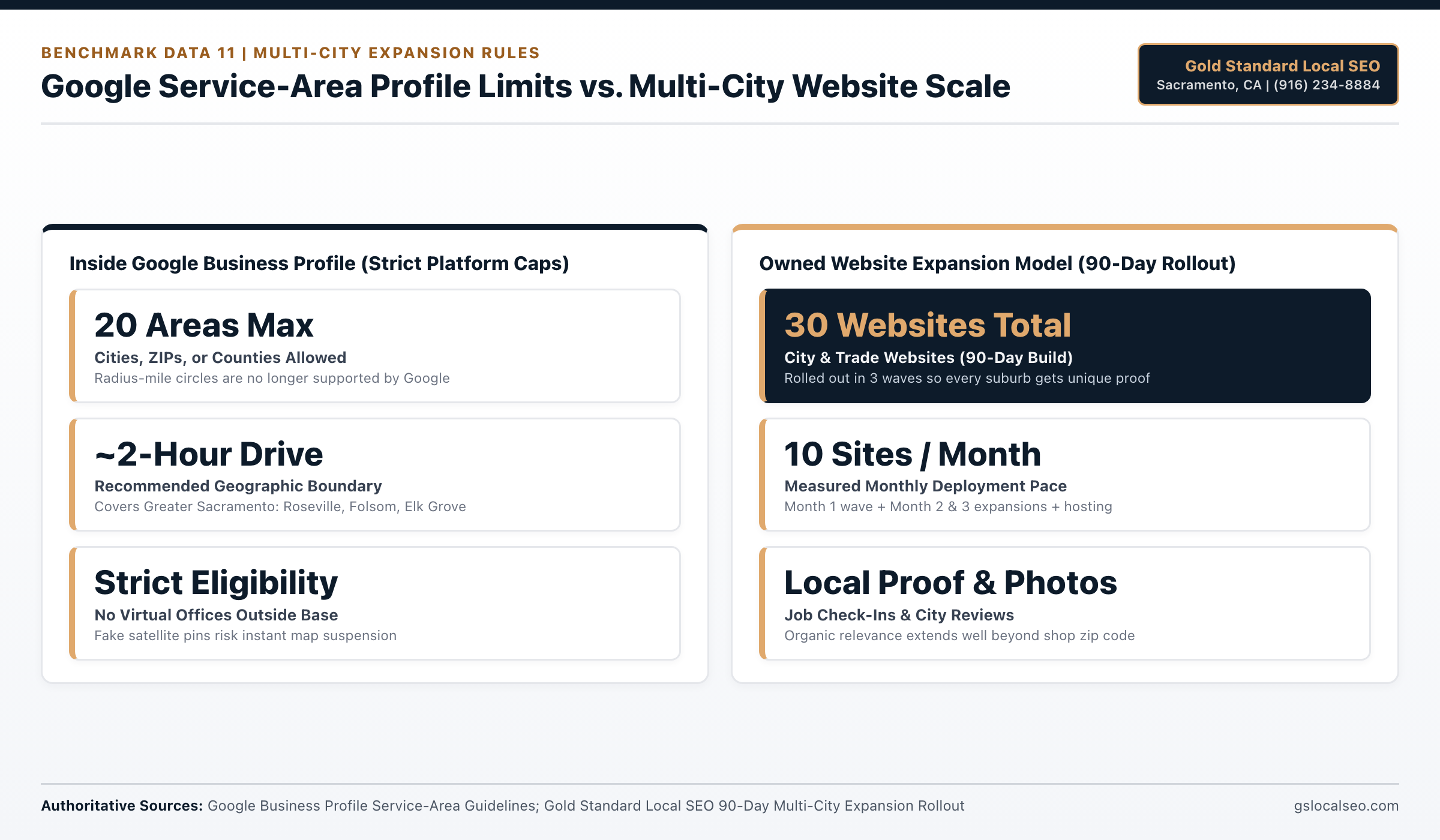
| Expansion Lever | Verified Cap or Rollout Pace | Best Use for Sacramento Roofers | Primary Authority Source |
|---|---|---|---|
| GBP Service Area Cap | Up to 20 named cities, ZIPs, or counties | Select top suburbs; radius miles unsupported | Google Business Profile Help |
| GBP Distance Guideline | Stay within ~2-hour driving time from base | Sacramento to Roseville, Folsom & Elk Grove | Google Business Profile Help |
| City & Trade Website Rollout | 10 websites per month over 3 months (90 days) | Builds 30+ unique local proof assets safely | Gold Standard Local SEO Plan |
| On-Page Organic Share | 33% of Local Organic ranking weight | Dedicated suburb pages win beyond shop zip | Whitespark Ranking Factors |
| Mobile Search Action Window | 76% visit within 24 hrs / 88% in 7 days | Turn suburban searches into booked inspections | Think with Google |
Sources: Google Business Profile Service-Area Guidelines; Whitespark Local Search Ranking Factors; Think with Google; Gold Standard Local SEO Field Rollout.
Local Sacramento Valley Roofing & Climate Considerations
Expanding service territory operations across Placer, El Dorado, and Sacramento counties requires navigating varied municipal requirements.
Pricing, Scope & Contractor Fit Requirements
First-hand Greater Sacramento field testing (Folsom, Roseville, and Citrus Heights C-39 contractor campaigns) shows map-pack calls scale fastest when pricing and scope match your crew capacity:
- Flat Monthly Rate: $297/month for single-city Google Business Profile management, Automated Past & Future Customer 5-Star Review Campaign, and speed-to-lead intake; $0 setup fees and month-to-month terms with zero 12-month contracts.
- Multi-City Expansion Option: Full 30-website city and trade rollouts build at 10 websites per month over 90 days so every target zip code indexes cleanly.
- Best Fit: Active California CSLB C-39 licensed roofing contractors carrying mandatory workers' compensation coverage who want $15,000+ roof replacement and commercial repair calls without paying shared lead brokers.
- When to Wait: Brand-new startups without an active CSLB license, zero completed customer jobs, or no crew capacity to answer estimate calls within 60 seconds.
Next Guide in the Series
Driving high-intent calls from multiple cities across the Sacramento region is useless if your team is too slow to answer the phone. Learn how automated call routing and instant SMS notifications capture the job before your competitor can respond in our next guide: How Fast Should a Roofing Company Call Back an Emergency Web Lead?.
Build Your Sacramento Roofing Lead Engine
At Gold Standard Local SEO (Folsom & Sacramento, CA), we deploy dedicated city and trade websites, Google Business Profile optimization, and our Past & Future Customer 5-Star Review Engine. Flat $297/month. Month-to-month terms with zero lock-in contracts.
Call (916) 234-8884 to Get Started Today